Knowing Souls Before Teaching Texts
How revelation gave the Prophet ﷺ a map of human souls before the encounter, making the discernment of temperaments the foundation of every caller's success
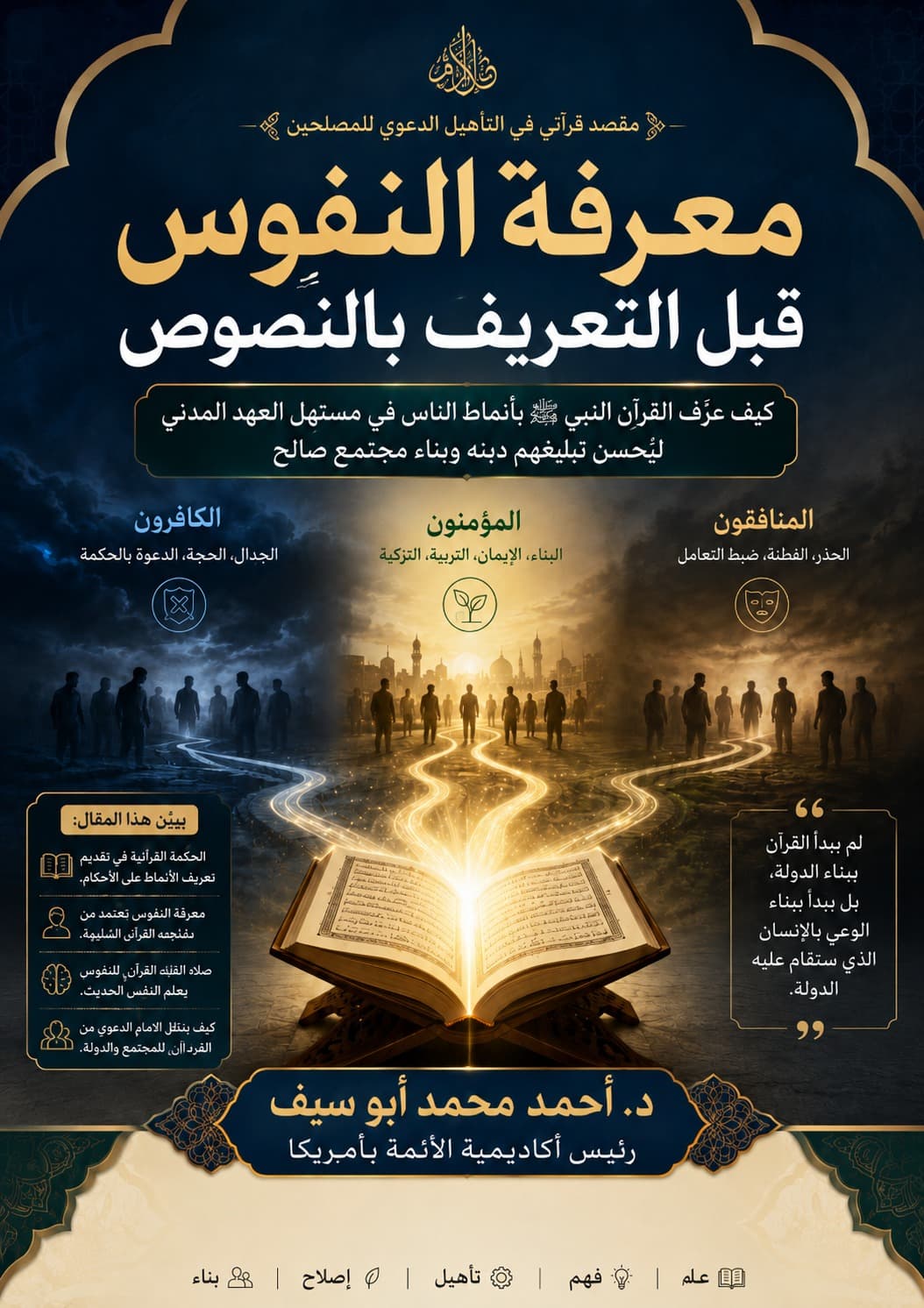
How revelation acquainted the Prophet ﷺ with the types of people at the threshold of the Medinan era, that he might convey his religion to them well and build a righteous society. By Dr. Ahmed Mohamed Ali Abouseif, President of the American Imams Academy.
At the threshold of the great endeavour of calling people to God which the Prophet ﷺ was about to undertake — the day God carried him from a hunted, hounded mission in Mecca to the building of a nation and a state in Medina — there came to him the divine acquaintance with the types of people he would meet. The first thing he received in his new era was thus a map of souls, not of soil. And perhaps in this ordering — placing the knowledge of a people before the encounter with them — there lies an eloquent secret. For the commander before whom the map of the field is spread out before battle enters it with insight, while he who knows nothing of his ground wades into it blind. So God willed for His Prophet to know souls first, before acquainting them with the texts of his religion; for knowledge of hearts is the key to applying the word soundly upon them. This relationship between the discernment of temperaments and the excellence of conveyance is the subject of this article.
First: The Qurʾanic Foundation — "And We sent no messenger except in the language of his people"
The principle upon which this entire idea is built is the saying of God Most High: ﴿And We did not send any messenger except in the language of his people, that he might make [things] clear to them﴾ [Ibrāhīm: 4]. God made conformity with those sent to a condition of the sending itself, not an addition appended to it. The exegetes hold that the purpose of "language" is clarity and comprehension in the tongue the people knew and understood. Ibn Kathīr said that it is from God's gentleness toward His creation that He sends to them messengers from among themselves, in their own tongue, so that they may understand from them what they intend (1). From this verse the people of daʿwah have plainly derived that knowing the language of those one calls, and addressing them in what they comprehend, is among the essential instruments of the call.
Yet "the language" in the verse is broader than mere verbal speech. It does not stop at the vocabulary and grammar of a tongue, but reaches beyond them to the language of hearts and souls, to the familiar customs of a shared culture, and to the avenues of temperament through which a people understand and are moved. Spoken language is the outward face of the tongue, and the discernment of souls is its inward depth; whoever addresses a people in their own words while ignorant of their natures has spoken only half their language. Upon this, acquaintance with the types of people enters into the general meaning of "the language" that God made a condition for every messenger — it is not outside it.
The Context and the Timing
It is firmly established among the people of exegesis and the Qurʾanic sciences that Sūrat al-Baqarah is Medinan without dispute, and that it is among the earliest revealed in Medina after the migration — not on the road toward it before entering. It did not descend all at once, nor while he ﷺ was still journeying from Mecca, but after his settling, and it came down piecemeal over years. Its opening portions, however — including the verses that classify mankind — were among the first to be revealed at the threshold of the Medinan era. So the right thing to say is: God acquainted His Prophet with the types of people upon the very doorstep of his new phase, just as he began to build the society.
This classification is stated explicitly in the well-known report of Mujāhid: four verses at the opening of the sūrah concern the believers, two verses after them concern the disbelievers, and thirteen verses after that concern the hypocrites (2). Consider this: the longest of the three passages is the passage of the hypocrites. That is so only because hypocrisy is the most hidden of the categories and the most dangerous, and it is a Medinan phenomenon that Mecca had not known — for hypocrisy arises only when the call gains strength and a state, which tempts weak souls to display what they do not inwardly hold.
This acquaintance was no luxury of expression; it lay at the very heart of the sūrah's aims. Its revelation came at the dawn of establishing the Muslim society and securing its independence within its city, so that among its first objectives was the purification of this society from the corrupting elements that worm their way into it. And purifying a society begins with knowing its elements; for no crop is cleansed of its chaff until the crop is first distinguished from the chaff.
Second: Why Acquaintance Before the Encounter?
In placing acquaintance before the meeting there is a profound wisdom, perceived by considering the nature of the task. The Prophet ﷺ was approaching a composite society he had not known before: believing Anṣār, the Jews of Medina with their stances, and hypocrites who concealed other than what they displayed. Had he entered this mixture without prior acquaintance, he would have received every face by its surface, and would have expended of his time and effort what a man expends when he discovers natures one by one through painful experience.
But when acquaintance precedes the endeavour, the caller (dāʿiya) enters his field with the keys to hearts in his hand before he knocks upon their doors. He knows that the believer is addressed in the language of certainty and building; that the obstinate disbeliever is not won by prolonging dispute; and that the hypocrite is dealt with through caution and vigilance, while the manifest proof is established against him. Prior acquaintance spares the caller years of error and trial and grants him an insight that delivers him from many a stumble.
Moreover, in prior acquaintance there is a mercy to the caller himself. He who meets denial and abandonment without expecting it is broken and despairs; but he who knew beforehand that among people there is a disbeliever who will turn away and a hypocrite who will fail him receives this with a steadfast heart that does not waver, for it was already in his reckoning. Knowledge of the categories of people is a fortification of the self before it is a management of the situation.
Third: The Caller's Gain Through the Discernment of Temperaments
If it is established that acquaintance is a divine grace, then the caller must seek this discernment and strive to attain it; for not every acquaintance descends as revelation — rather, most of it is acquired through reflection, practice, and contemplation of the Book of God. The caller's gain through this discernment appears in several aspects.
The first is sound application; for a single word may benefit in one setting and harm in another. The caller who reads the type of the one he addresses places every word in its rightful place: he is gentle where gentleness benefits, firm where nothing serves but firmness, and silent where silence is more eloquent than speech.
The second is the economy of effort; for the energy of daʿwah is limited, and whoever squanders it upon one from whom no good is hoped has wasted it upon one who would have profited from it. The discernment of temperaments shows the caller where to place his effort, so that he does not spend his life convincing the obstinate while an open heart awaits him, having found none to take it by the hand.
The third is the heart's safety from temptation; for he who is ignorant of people's natures may be beguiled by the adorned surface of the hypocrite, or despair of the inner state of the failing believer. But he who has discerned the types weighs people on a just scale that no glitter deceives and no surface misleads.
Fourth: Witnesses from the Prophetic Biography That It Is an Obligation, Not Merely a Virtue
The discernment of souls in daʿwah is not a chapter of supererogation and recommended perfection; it is an obligation upon which the very success of conveyance depends. The truest witnesses to this are the practical episodes of the Prophetic biography, which turn theory into proof.
Muṣʿab and His Discernment of the Chiefs of the People
When the Prophet ﷺ sent Muṣʿab b. ʿUmayr as the first envoy to Yathrib after the First Pledge of al-ʿAqabah, his unparalleled success was not the fruit of his sincerity and beautiful recitation alone, but the fruit of his discernment of the people's souls and natures. He used to lodge with Asʿad b. Zurārah, who introduced him to the chiefs of Medina and their positions, and alerted him whenever a chief approached whose Islam might bring with it the Islam of his tribe. So Muṣʿab made for the chiefs and the leaders by deliberate design — knowing that the Islam of a chief draws his people after him — until there embraced Islam at his hands Saʿd b. Muʿādh and Usayd b. Ḥuḍayr, the two chiefs of their people, and by their Islam a great multitude entered the faith (3).
Were it not for this discernment of souls, his call would have remained a scattered, individual effort; but once he knew the avenues into the people and the keys to their tribes, he carried Islam to the whole of Medina in a handful of months, and paved the way for the Prophet's migration ﷺ to a land made ready to receive him. The discernment of temperaments was thus the bridge across which the call passed from individuals to a society.
The Prophet ﷺ and His Knowledge of the Arabs' Ways of Discourse
As for the Prophet ﷺ, he was the most knowing of people regarding the types of the Arabs and their manner of receiving discourse. Had he — and far be it from him — entered upon them ignorant of the pathways of their souls, they would have found his speech distasteful and the call would have been lost at its very beginning, for they would have ascribed that to a paucity of his experience with them. But since he was knowing of their natures and expert in the points at which they could be persuaded, the disdain of the obstinate stood exposed as a contrived affectation, and their claims fell to nothing in the eyes of high and low alike.
Here lies a subtle benefit that surpasses mere excellence of address: the one who knows souls does not merely address them well — he lays bare the pretence of his adversary and exposes the falsity of his opposition. Because he knows from where the obstinate man is approached, he closes upon him the doors of evasion, and his affectation is unmasked before all the people. Knowledge of temperaments is thus a double-edged weapon: an excellence of building for the one who draws near, and an unmasking of the schemes of the one who turns away in obstinacy.
Fifth: The Loss of the One Deprived of This Insight
By contrast, the caller who wades into his endeavour without discernment of temperaments incurs grievous losses. The first is that he treats all people in a single mould, addressing the obstinate with the gentleness owed the believer, and the believer with the firmness owed the obstinate, so that his effect comes out reversed: he repels the one he meant to win over, and emboldens the one he meant to deter.
The second is that he drains himself in the wrong places; he wears out his life debating one whose heart is sealed, and neglects one who, had he but extended a hand to him, would have come forward. How many a caller has wasted years in a losing battle with an obstinate man, while around him hearts that awaited a single word were lost!
The third — and it is the most dangerous — is that he breaks down within himself when struck by what he did not anticipate; he takes the hypocrite's betrayal as a failure of his own, and the disbeliever's obstinacy as a deficiency in his call, and so enters a spiral of self-blame and despair. The one ignorant of temperaments carries the burdens of others upon his own back, while the one who knows them lays each burden where it ought to lie.
Sixth: The Root of Psychology in the Qurʾan
Perhaps the most wondrous matter in this domain is that what modern psychology has arrived at — the distinction between personality types and the classification of temperaments — has in the Qurʾan a precedent that is both prior and deeper. Psychology classifies people according to outward behaviour and reactions; the Qurʾan, however, classifies them according to the reality of the heart and its relation to the truth — and that is the deeper classification upon which all behaviours are built.
When the Qurʾan describes the hypocrite as one in whose heart is a disease that God increases in disease, and as one who oscillates between two states, [belonging] neither to these nor to those, it describes with precision what the moderns call inner contradiction and the splitting of the personality. When it speaks of the soul that incites to evil, the self-reproaching soul, and the soul at peace, it draws the stages of psychological maturity through which a person ascends. And when it shows man's fitness for both good and evil — ﴿and inspired it [with discernment of] its wickedness and its righteousness﴾ [al-Shams: 8] — it establishes that duality of potential around which all of moral psychology turns.
The essential difference is that psychology describes but does not heal from the root, whereas the Qurʾan describes in order to heal. It does not classify people to imprison them within their types, but to open for each type the door of change and ascent. The disbeliever may come to faith, the hypocrite may repent, and the soul that incites to evil may attain peace; the Qurʾanic classification is a diagnosis that aims at a cure, not a verdict that perpetuates the malady.
Conclusion
We return to the image with which we began: the commander before whom the map of the field is spread out before battle. God willed for His Prophet ﷺ, standing upon the threshold of building a nation, to enter his field with insight into the souls he would mingle with. So He acquainted him with the believer, that he might build with him; with the disbeliever, that he might be wary of him; and with the hypocrite, that he might guard against his scheming. Nor was that an acquaintance for his person ﷺ alone, but a way for every caller after him: to seek the discernment of temperaments before he knocks upon hearts, thereby winning sound application, the economy of effort, and the safety of the self, and escaping the losses of the ignorant man who treats all people in a single mould. Whoever reads the map of souls walks well in the field, and whoever wades in without a map goes astray though his intention be true. That is an insight God bestowed upon His Prophet at the outset of the road: to know souls before acquainting them with texts — and he left it as an inheritance to everyone who, after him, carries the trust of the word.
Note (1): The saying of God Most High, "And We sent no messenger except in the language of his people, that he might make [things] clear to them" [Ibrāhīm: 4]. See its exegesis in al-Ṭabarī's *Jāmiʿ al-Bayān*, Ibn Kathīr's *Tafsīr al-Qurʾān al-ʿAẓīm*, and al-Qurṭubī's *al-Jāmiʿ li-Aḥkām al-Qurʾān*, and the words of Ibn ʿĀshūr in *al-Taḥrīr wa-l-Tanwīr* on the breadth of the meaning of "the language."Note (2): The report of Mujāhid on the division of the opening of Sūrat al-Baqarah (four [verses] on the believers, two on the disbelievers, and thirteen on the hypocrites): mentioned by al-Ṭabarī in *Jāmiʿ al-Bayān* in the introduction to his exegesis of the sūrah, and alluded to by Ibn Kathīr and Sayyid Quṭb in *Fī Ẓilāl al-Qurʾān* at its opening.Note (3): The story of the sending of Muṣʿab b. ʿUmayr as envoy to Yathrib and the Islam of Saʿd b. Muʿādh and Usayd b. Ḥuḍayr at his hands: reported by Ibn Hishām in *al-Sīrah al-Nabawiyyah*, and it is among the renowned events of the Prophetic biography.
Comments
Share a benefit or a thought about the article — we welcome your view.
No comments published yet. Be the first to comment.