Steadfastness Between the Indications of the Sacred Texts and the Response of the Human Soul
A Reflection from the Monthly Gathering at the American Imams Academy Masjid (AIA) — Texas
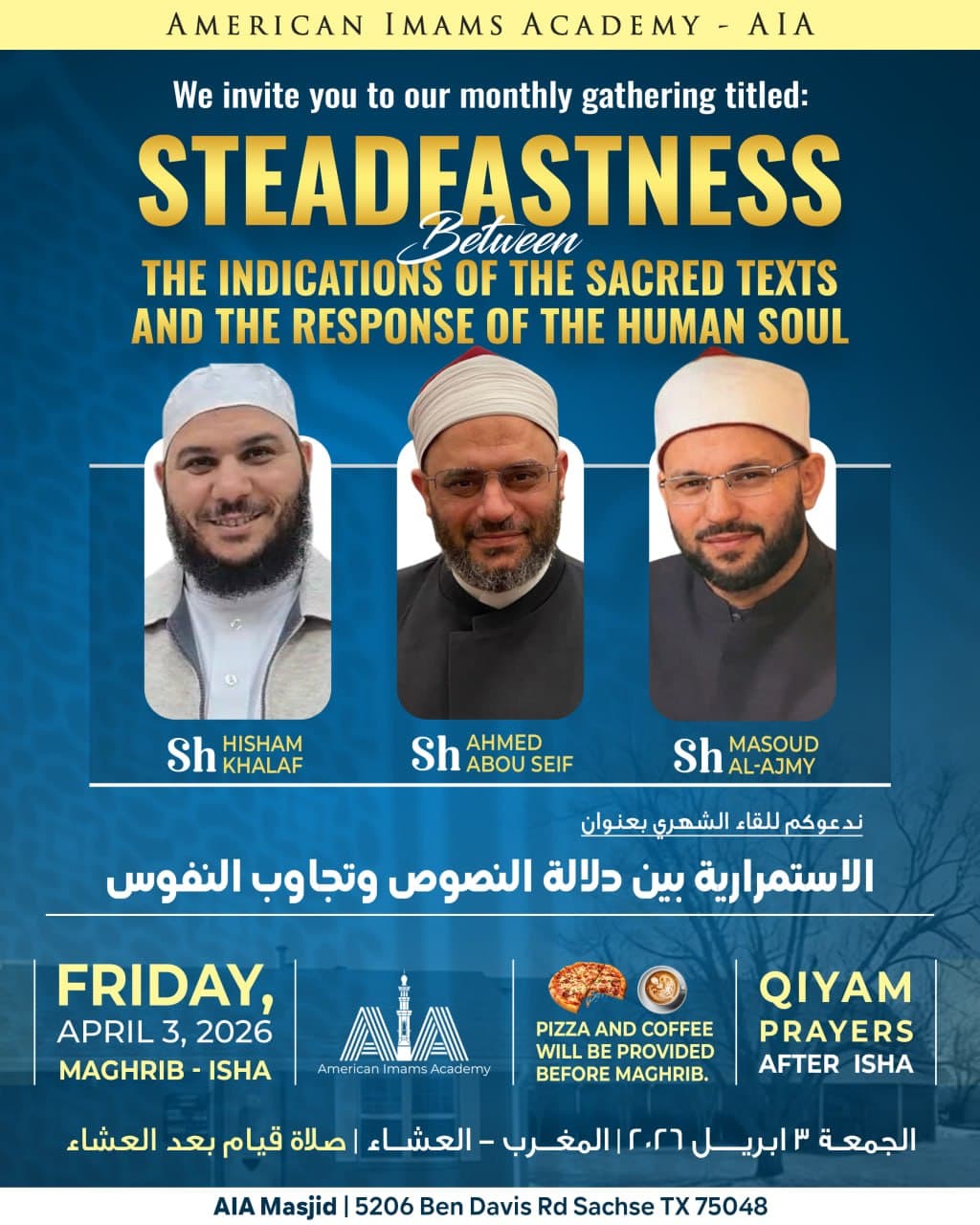
By Dr. Ahmed Mohamed Ali Abouseif, President of the American Imams Academy.
An Opening from the Heart of the Gathering
That night, we gathered at the American Imams Academy Masjid in Sachse, Texas. A question stood quietly in our hearts before it was ever spoken from the pulpit: What remains of Ramadan after it has departed? Are these merely numbered days evaporating like its own, or is the true fasting person one who turned Ramadan into a launching pad rather than a finish line?
The title of the gathering was *"Steadfastness Between the Indications of the Sacred Texts and the Response of the Human Soul"* — a title that carries a profound duality: the constancy of revelation (the indications of the texts) and the volatility of the human reality (the response of souls). In the space between the unchanging text and the wavering soul lies the very core of every educational and pastoral challenge that comes after each season of worship.
First: The Convergence of the Texts on the Meaning of Continuity
The sacred texts do not merely allude to continuity — they erect a coherent structure upon it, all speaking with different voices toward a single meaning. When Allah addressed His Prophet ﷺ, He said: *"So remain on a right course as you have been commanded, and those who have turned back to Allah with you"* (Hūd 11:112). Steadfastness here is an ongoing imperative, not a passing condition. When the Prophet ﷺ was asked to summarize the entire religion in two words, he said to Sufyān ibn ʿAbdillāh al-Thaqafī: *"Say: I have believed in Allah — then remain steadfast."* He combined the root of faith with its operative fruit: perseverance.
The Prophet ﷺ then placed the governing standard for evaluating any deed: *"The most beloved deeds to Allah are the most enduring, even if they be few."* Notice the precision: he did not say "the most" or "the greatest," but "the most enduring." Duration, not quantity, is the measure. ʿĀʾisha (may Allah be pleased with her) confirmed this when she described his practice: *"His deeds were like a gentle, continuous rain (*dīma*)"* — steady drizzle, not a flood that surges and then recedes. And he warned ʿAbd Allāh ibn ʿAmr: *"O ʿAbd Allāh, do not be like so-and-so, who used to pray at night and then abandoned night prayer."* Abandoning what one had habituated himself to is itself blameworthy.
The most striking Qurʾānic image for the one who undoes his work after perfecting it is in the verse: *"And do not be like she who untwists her thread, after spinning it strongly, into untwisted strands"* (al-Naḥl 16:92). Contemplate the picture: a woman who spent her day spinning with strength and discipline, then sat at evening pulling apart what she had woven. This is the state of one who excels in Ramadan and then, after Eid, unravels everything he has built. What is remarkable is that "untwisting after strength" is worse than never having spun at all — for it adds the loss of effort to the loss of outcome.
From the side of the Qurʾān, His saying *"And worship your Lord until certainty comes to you"* (al-Ḥijr 15:99) makes the ceiling of worship death itself, not season's end. And *"Indeed, my prayer, my sacrifice, my living, and my dying are for Allah"* (al-Anʿām 6:162) makes worship an identity that absorbs the entirety of life, not a series of scattered events.
Second: Purification Is a Path, Not a Moment
Among the most exquisite features of the Qurʾān is that the verb in the verses of purification appears in the present-continuous form: *"and He purifies them"* (*yuzakkīhim*), not "and He purified them." The present tense, as is well known, denotes ongoing renewal. Purification (*tazkiyah*) is not a moment that expires with the end of Ramadan; it is a sustained, evolving practice that tracks the development of the human soul. This is the great rule on which every Islamic educational structure rests: worship is a lifelong project, not a seasonal act.
At its core, *tazkiyah* combines two movements: emptying (*takhliyah*) — purging the soul of its vices — and adorning (*taḥliyah*) — filling it with virtues. Neither happens in a single sitting; both require continuous *hijrah* (departure) from sin, sustained *muwāẓabah* (consistency) on obedience, and gradual *ziyādah* (increase) in good. As the scholars say: *"Among the signs of an accepted good deed is the good deed that follows it."* Continuity itself is the evidence of acceptance, and a servant's disconnection after a season of worship may be a sign of forsaking, not of rest.
Continuity, understood this way, is not an additional act; it is the very test of the sincerity of the first act. Whoever tasted the sweetness of faith in Ramadan and then peeled it off in Shawwāl has shown that what moved him was the season — not the faith.
Third: Perseverance Is the Path to Divine Love
The Prophetic ḥadīth qudsī then draws the farthest horizon for perseverance, linking it not merely to reward but to the love of Allah Himself. The Prophet ﷺ reports from his Lord: *"My servant does not draw near to Me with anything more beloved to Me than what I have made obligatory upon him. And My servant continues to draw near to Me through voluntary works until I love him. When I love him, I become his hearing by which he hears, his sight by which he sees..."*
Notice the construction: *"continues to..."* — a grammar of ongoing-ness. This is not intermittent or seasonal worship; it is sustained, daily nearness through supererogatory acts. And the fruit is not a calculated reward, but God's love itself — and whoever Allah loves is granted true direction in his hearing, his sight, his hand, his foot. Continuity, therefore, is not a heavy obligation; it is a doorway to the highest stations of servitude.
Fourth: The Response of Souls — Patterns of People After the Seasons
Human souls receive these unchanging texts in markedly different ways. Some respond; some soften then harden; some resist. The Prophet ﷺ pointed to this variance: *"People are like the metals of gold and silver."* Each soul has its metal, and each metal has its own particular response. Below are the most recurring patterns observable in people after seasons of worship:
| Pattern | Description | Relation to the Texts | Educational Challenge | |---|---|---|---| | 1. The Transactional Accountant | Treats deeds as transactions; watches for the large rewards and asks about "profits" before acting. Active during the last ten nights of Dhū al-Ḥijjah and on Laylat al-Qadr, yet neglects the two units of Ḍuḥā and the morning remembrances. | Links action only to the explicitly named reward, and is unmoved by silent acts of obedience that carry no advertised virtue. | Move him from being a "merchant with God" to being a "servant of God"; teach him that Allah loves the servant even when his deeds are small, and that consistency is itself a hidden multiplier. | | 2. The Seasonal Worshipper | Opens his "store" with Allah in Ramadan and closes it at Shawwāl: prays Tarāwīḥ and then abandons the mosque, completes the Qurʾān many times and then does not open it again until next year. As the early generations said: *"What a wretched servant is one who knows his Lord only in Ramadan."* | Reads Ramadan's texts with passion and neglects the texts of daily life. | Remind him that "the Lord of Shaʿbān is the Lord of Ramadan"; train him to retain a daily trace of the season, however small. | | 3. The Exhausted Enthusiast | Exits Ramadan with high voltage, then imposes upon himself more than he can bear — night prayer, fasting, litanies — until he tires and stops completely. | Clings to texts of high effort and overlooks texts of gentleness. | The Prophetic remedy is explicit: *"Take on of deeds only what you can bear, for Allah does not tire until you tire,"* and *"Aim for the right path, draw near it, and rejoice."* | | 4. The Emotional Impulsivist | Moved by a stirring word in a gathering, he weeps and resolves — then forgets the moment he leaves. His feeling is sincere but, like a matchstick, brief: a flame, then ash. | Engages texts of encouragement and warning, but weakens before texts of dry obligation. | Convert emotion into a concrete commitment: leave every gathering with one small, executable decision. | | 5. The Perfectionist | Adopts the all-or-nothing principle: if he cannot pray half the night, he will not pray; if he cannot finish the Qurʾān in a week, he will not read it. Dresses the refusal of commitment in the garments of sincerity. | Ignores texts of "the small and continuous" and celebrates only texts of high effort. | Teach him the fiqh of perseverance: the small and steady is better than the great and discontinued. Gradualness is the Sunnah of revelation. | | 6. The Formalist with Inner Disconnect | Preoccupied with the outer shape of worship while it bears no fruit in his conduct. Lavish with the physical purification of his body before prayer, yet does not purify his heart of envy. Pays zakāh but cheats his employees. Performs Hajj and ʿUmrah while severing ties of kinship. | Treats the texts as ritual gestures, not as a curriculum that shapes a human being. | Reconnect worship to its objectives: *"And the Religion is nothing but social dealings,"* as the scholars said. | | 7. The Environmentally Dependent | His steadiness is contingent on those around him: fasts because everyone fasts, but cannot pray on his own. His resolve disperses when the crowd disperses. | Reads the texts of community (*"and hold firmly together"*) but neglects the texts of solitude (*"and mention the name of your Lord"*). | Build a permanent righteous companionship (a Qurʾān circle, a masjid community), and gradually train him in the worship of solitude. | | 8. The Procrastinator | Forever intending, perpetually deferring. He has a library of projects that will begin "tomorrow," "after exams," or "when life settles down." | Disregards the texts on the brevity of life and the suddenness of death (*"And no soul knows what it will earn tomorrow"*). | Break the logic of waiting: begin immediately at the smallest possible scale; readiness arrives with action, not before it. | | 9. The Repenting Relapser | Caught in a cycle of standing and falling: steady for a week, lapses for a week, regrets, then returns. The danger is that he may eventually despair of himself. | Engages texts of encouragement, then withdraws at the first failure. | Remind him of the wide door of repentance; give him a realistic plan to shorten the cycle of relapse, not wait for perfection. | | 10. The Self-Reliant Deceived | Imagines that what he offered in Ramadan was by his own strength and resolve, holds a high opinion of himself, and forgets to ask Allah for help in continuing. | Reads the texts with the eye of accomplishment, not the eye of need. | Remind him that steadfastness is a divine gift, not a personal skill. *"None has any power except by Allah."* Whoever is left to himself is destroyed. |
These patterns are not rigid walls between people. A single person may move among them depending on his state and life stage. What matters is that the educator does not address them all with one breath; each pattern has its own entry point and its own language of response.
Fifth: Why Do Souls Differ in Their Response?
The variance of human souls is neither accidental nor a flaw in the texts; it is a universal pattern. The Qurʾān itself presents two contrasting models for receiving remembrance: *"And when Allah is mentioned alone, the hearts of those who do not believe in the Hereafter shrink with aversion"* (al-Zumar 39:45), versus *"those who have believed, and whose hearts are reassured by the remembrance of Allah"* (al-Raʿd 13:28). A single human heart is capable of recoil and of reassurance alike; the reminder is the same — but the receivers differ.
The differences trace back to many factors: early upbringing, social environment, personal temperament, religious literacy, life pressures, and stage of age. This is why the Prophet ﷺ said: *"Indeed, deeds are only by intentions,"* anchoring evaluation in the inward, and: *"Allah does not look at your forms or your wealth, but He looks at your hearts and your deeds."* When the educator understands that people are metals, he ceases pouring every metal into a single mould.
Sixth: Struggle (*Mujāhadah*) — The Bridge Between the Text and the Response
How do we move from a text that calls to uprightness, to a soul that is actually upright? The answer lies in one word: *mujāhadah* — sincere struggle. *"And those who struggle for Us — We will surely guide them to Our paths"* (al-ʿAnkabūt 29:69). It is the bridge over which one crosses from knowledge to action, from intention to deed, from resolve to perseverance. Do not underestimate small struggles; whoever struggles to keep two units of the regular Sunnah every day is — in the divine balance — greater than one who struggled to pray half the night for a week and then stopped.
Imām Aḥmad ibn Ḥanbal was once asked: "When does the servant find the taste of rest?" He gave his immortal answer: *"When he places his foot in Paradise."* Absolute rest is not in this world; this world is a domain of struggle and endurance. This understanding alone shields the servant from despair when perseverance feels heavy — because he knows that the very heaviness is the road itself.
Seventh: The Prophetic Balance — A Lesson from ʿAbd Allāh ibn ʿAmr
Many sincere souls, after Ramadan, fall into the trap of "exhausted enthusiasm" — they impose upon themselves more than they can bear, exiting Shawwāl weaker than they entered Shaʿbān. The Prophet ﷺ placed the remedy in the well-known account of ʿAbd Allāh ibn ʿAmr, who fasted by day and prayed by night without rest. The Prophet ﷺ told him: *"Indeed your body has a right over you, and your eye has a right over you, and your spouse has a right over you, and your guest has a right over you."*
Notice the sequencing: body, eye, spouse, guest. None of these rights may be crushed under the foot of an overstretched devotion. Balanced uprightness does not demolish the home to build the masjid, nor exhaust the body to revive the heart. Islam grants every right-holder their due, and continuity is the daughter of balance, not the offspring of excess.
Eighth: How Do We Turn Listlessness Into Continuity? — Practical Steps
A summary of guidance useful for every pattern and every reader:
1. Shift your relationship with worship from "event" to "identity." Do not say "I fast Ramadan"; say "I am a servant of Allah, and fasting is one branch of my servitude." Identities continue; events expire.
2. Shrink the deed, but do not drop it. If you cannot complete the Qurʾān in a week, do it in a month. If you cannot pray half the night, settle for two units. If you cannot give a dinar, do not leave the date. The Prophetic rule: *"Take on of deeds only what you can bear."*
3. Build a system, not a mood. Enthusiasm fades; systems endure. A modest daily portion of Qurʾān, morning and evening adhkār, a small daily charity — small, consistent systems make the largest transformations.
4. Measure yourself by the week, not the day. A day may be lukewarm or vibrant; the week reveals the actual direction.
5. Engineer your environment. Companionship is a pillar of steadiness, not a luxury. *"A person is upon the religion of his friend, so let one of you look carefully at whom he befriends."* Choose a masjid, a circle of knowledge, a group of righteous companions — do not leave it to chance.
6. Do not despair after a fall. Repentance is itself an act of worship. *"All children of Adam are sinners, and the best of sinners are the repentant."* The relapser is not a failure — he is in a test.
7. Be utterly poor before Allah; do not be deceived by your works. Always say: *"O You who turn hearts, anchor my heart upon Your religion."* Steadfastness is a gift, not a skill; whoever is left to himself perishes.
8. Remember: Allah does not tire until you tire. The door is never closed as long as you keep knocking. A little with Allah is blessing; a great deal without continuity is dust.
Ninth: Which Pattern Are You? — A Mirror Moment
Read the ten patterns again, and ask yourself honestly: *In which pattern do I see myself most?* Am I moved by numbers and great rewards? Does my religion end with the end of the season? Do I exhaust myself in the first week of Shawwāl and break by the second? Are my tears in the gathering more eloquent than my resolve after it? Am I a victim of perfectionism, abandoning the little? Has my worship become divorced from my character? Is my steadiness dependent on those around me? Do I promise myself every night that I will start tomorrow? Am I in an endless cycle of standing and falling? Do I look upon my works with my own eye, rather than the eye of God's favor?
Do not stop at reading. Take a sheet, write the pattern closest to you, and beneath it write one single step you will commit to this week. A small, clear, measurable step. That sheet — modest as it is — may be the greatest thing you take from this article.
Conclusion: The Steadiness of the Text Calls Forth the Steadiness of the Soul
The texts converged on a single meaning; let our souls meet at that meaning. The One who created us knows we grow weak — yet calls us not to surrender. He knows we fall short — yet calls us not to disconnect. He knows the seasons pass — yet calls us to keep some of their light illuminating the rest of the year.
What comes after Ramadan is not emptiness; it is extension. What comes after the season is not an ending; it is a new beginning. Steadfastness is not to remain on the mountain peak, but to descend to the valley without breaking. The texts show the path; the soul does the walking; and the true believer is one who treated Ramadan as a *charging station*, not a *farewell party*.
O Allah, make us among those who *"then remained steadfast,"* let our deeds be gentle and continuous like the guidance of Your Prophet ﷺ, and let our hearts be firmly anchored upon Your religion until we meet You.
American Imams Academy Masjid (AIA) — 5206 Ben Davis Rd, Sachse TX 75048* *Monthly gathering — Friday, April 3, 2026 — between Maghrib and ʿIshāʾ — followed by Qiyām after ʿIshāʾ.
Comments
Share a benefit or a thought about the article — we welcome your view.
No comments published yet. Be the first to comment.