Wisdom is the Lost Property of the Believer
A Foundational Reading of a Cherished Maxim and a Contemporary Civilizational Dilemma
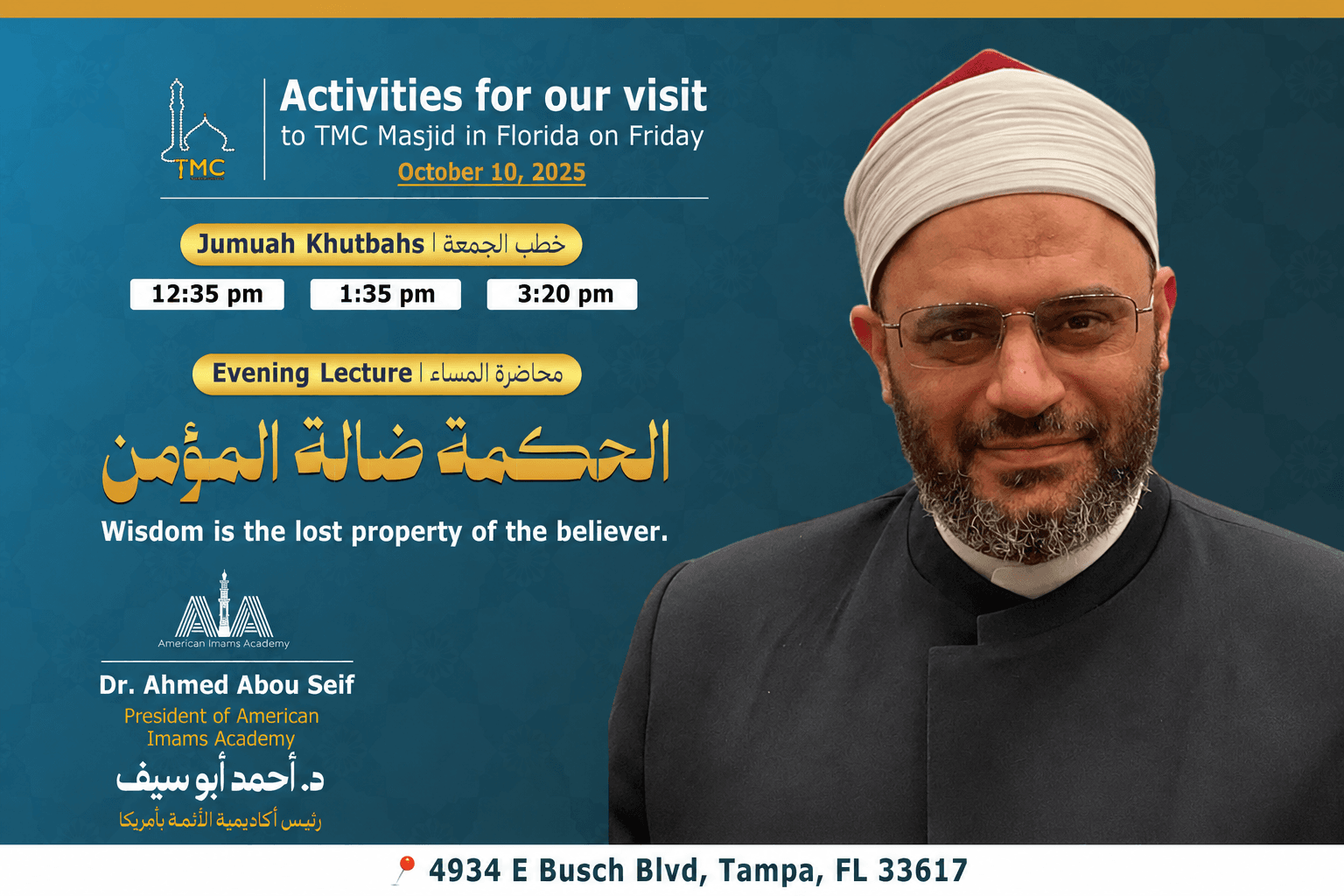
By Dr. Ahmed Mohamed Ali Abouseif, President of the American Imams Academy.
An Opening: A Cherished Maxim That Sums Up an Entire Philosophy
A widely circulated maxim, received by the people with general acceptance, declares: *"Wisdom is the lost property of the believer; wherever he finds it, he is most worthy of it."* It has been transmitted as a marfūʿ ḥadīth from Abū Hurayra (may Allah be pleased with him), recorded by al-Tirmidhī and Ibn Mājah, though its marfūʿ chain has been judged extremely weak by the majority of ḥadīth specialists, and it cannot be confidently attributed to the Prophet ﷺ[1]. The meaning, however, is sound and weighty, supported by the Qurʾān and the authentic Sunna, and lived out in practice by the Companions and their successors. Of a similar genre, transmitted only with reservation, is the saying: *"Wisdom is the lost property of the believer; seek it even among the hypocrites."* It has been attributed to ʿAlī (may Allah be pleased with him), but we have not found for it a firm chain of transmission[2].
Reflect on the eloquent image the Prophet ﷺ chose: *al-ḍālla* — the lost beast that an owner pursues with longing, refusing to rest until he recovers it. Wisdom, for the believer, is not an optional accessory he may take or leave, but a *missing possession* he reclaims wherever he finds it. He looks for it in every gathering, searches for it in every book, listens for it on every tongue that speaks truth. Near or far, Muslim or non-Muslim — it makes no difference to him, as long as what he hears agrees with truth, benefits creation, and does not clash with the foundations of revelation.
In its brevity, this maxim places before us — the Muslims of the twenty-first century — a delicate civilizational equation: *How do we open ourselves to humanity's heritage without dissolving into it? How do we receive from others without losing our own foundations?* This is the question that will accompany us through every part of this article.
I. Defining Wisdom
Scholars have offered varied definitions of *ḥikma*, all revolving around a single great meaning. Mujāhid, al-Ḍaḥḥāk, and Imām Mālik are reported to have said that wisdom is *"deep understanding in the religion of Allah, paired with acting upon it"*[3]. Ibn al-Qayyim, in *Madārij al-Sālikīn*, defines it as *"doing what ought to be done, in the manner it ought to be done, at the time it ought to be done"*[4]. Al-Jurjānī, in *al-Taʿrīfāt*, describes it as *"the knowledge of truth for its own sake, and the knowledge of the good in order to act upon it"*[5].
The thrust of these definitions is that wisdom unites two inseparable elements: *beneficial knowledge*, and *righteous action that conforms to that knowledge*. The one who knows but does not act is no sage, even if he is a scholar; and the one who acts without knowledge is no sage, even if he is zealous. Wisdom grows in the soil between the twin trees of knowledge and action; neither can flourish without the other.
There is a third dimension often overlooked: the discernment of timing and the reading of context. A person may be both knowledgeable and active, yet open his mouth at the wrong moment and ruin the very meaning he sought to convey. Hence the rhetoricians' axiom: *"For every occasion, its own speech."*
II. Wisdom in the Book of Allah
Allah granted wisdom a lofty rank in His Book, saying: *"He grants wisdom to whom He wills, and whoever is granted wisdom has certainly been given much good. And none will remember except those of understanding"* (al-Baqara 269). The verse establishes three truths: that wisdom is a divine gift; that it is *much good*, so whoever attains it has truly profited; and that its reception and remembrance belong only to *those of understanding* — what Allah calls *ulū al-albāb*, possessors of sound reason.
Allah praised David (peace be upon him): *"We gave him wisdom and decisive speech"* (Ṣād 20). And He praised Luqmān the wise: *"We had certainly given Luqmān wisdom, saying, 'Be grateful to Allah'"* (Luqmān 12). So renowned did Luqmān become for his wisdom that Allah named a sūra after him — recited by Muslims until the Day of Resurrection.
Among the greatest missions of the prophets — peace be upon them — was *the teaching of wisdom*. Allah said of our Prophet Muḥammad ﷺ: *"It is He who has sent among the unlettered a Messenger from themselves reciting to them His verses and purifying them and teaching them the Book and wisdom"* (al-Jumuʿa 2). The teaching of wisdom is placed alongside the teaching of the Book, and paired with purification — a hint that wisdom is a fruit of faith and an outcome of inward refinement.
III. Wisdom in the Way of the Prophet ﷺ
The Prophet ﷺ was the foremost teacher of wisdom; every word from him was wisdom itself. al-Bukhārī and Muslim record that Ibn Masʿūd (may Allah be pleased with him) said: *"The Messenger of Allah ﷺ would attend to us with sermons selectively, disliking that we should grow weary"*[6]. He did not overwhelm them with exhortations until they tired of listening, nor stay silent so long that they forgot — but chose his moments and occasions with care. This itself is the very essence of wisdom in calling and teaching.
Among his concise maxims preserved by the Companions: *"The religion is sincere counsel"*[7]; *"Indeed, in eloquence there is enchantment"*[8]; *"Be detached from this world and Allah will love you; be detached from what people possess and people will love you"*[9]. Brief in form, vast in meaning — phrases on which a believer can build his entire conduct and method of life, all drawn from the pure stream of prophetic wisdom.
A phrase that circulates widely is *"The believer is shrewd and discerning."* A number of ḥadīth specialists — including Ibn al-Jawzī, al-Ṣaghānī, and al-Sakhāwī — have ruled that this phrase, with this wording attributed to the Prophet ﷺ, has no basis[10]. Our duty is to keep the Prophet's ﷺ legacy free of attributions that have not been authenticated, even if the meaning, in itself, accords with the spirit of the sharīʿa.
IV. Wisdom is Lost Property — But Where Is It Sought?
This is the heart of the maxim and the heart of this article. If wisdom is indeed the believer's lost property, then we must ask: *Whence is it taken? In which sources is it sought?*
The answer arranges itself in two concentric circles:
The First Circle: The Indispensable Great Sources
The first and greatest is the Book of Allah — *al-Ḥakam* (the Judge) and *al-Ḥakīm* (the Wise) — containing the news of those before us, what will come after us, and the law that governs us. The second is the Sunna of the Chosen One ﷺ; Allah revealed upon him both Book and wisdom, and many among the early generations interpreted "wisdom" in the verse to mean the Sunna itself. The third is the conduct of the noble Companions, the best of generations, from whom we take wisdom as it was lived. The fourth is the legacy of the practicing scholars — masters of jurisprudence, exegesis, and conduct, who embodied Islam as both knowledge and practice.
The Second Circle: The General Heritage of Humanity
There extends, beyond these, a wide door of wisdom — found in the experiences of nations and their civilizations, in contemplating the divine patterns at work in cosmos and society, in reading history and considering its outcomes, in sitting with thoughtful minds and listening to the accumulated experience of humanity.
Among the cherished sayings circulating on tongues — attributed to ʿUmar ibn al-Khaṭṭāb (may Allah be pleased with him) — is: *"Take wisdom; it will not harm you from whichever vessel it has come"*[11]. From the inherited speech of the early generations: *"Look at what was said, not at who said it."* And a saying related from more than one imām — including Mālik, Mujāhid, and Ibn ʿAbbās — declares: *"There is no one whose words are not taken and left, except the occupant of this grave"* — pointing to the grave of the Prophet ﷺ[12].
A Sharīʿa Boundary That Must Not Be Forgotten
Before we expand on this door, a sharīʿa principle must be established that governs all that follows: acceptable wisdom is that which conforms to truth and does not clash with the foundations of revelation. Not every theory or doctrine proposed by the human intellect is wisdom; rather, wisdom is what fulfills two conditions: its agreement with truth in itself, and its non-contradiction of the decisive teachings of the sharīʿa. If either condition fails, the speech departs from wisdom into misguidance, however ornamented it may be with philosophical terms and rhetorical flourish.
A Civilizational Equation: Openness Without Dissolution
In light of this boundary, the great dilemma the contemporary Muslim faces — especially those whom Allah has placed in the West — comes into focus: How does he open himself to the heritage of humanity without dissolving into it? How does he receive from others without losing his own self?
The answer lies in three precise distinctions:
First: the distinction between wisdom and reference. The believer takes wisdom from any source, but he does not replace the Qurʾān and the Sunna with another reference. Wisdom is gathered and weighed; the reference remains preserved and fixed. The Qurʾān judges over wisdom; wisdom does not judge over the Qurʾān.
Second: the distinction between benefiting and imitating. To benefit is to take from others what serves us, add it to what we already possess, and refine it through the standard of our sharīʿa. To imitate is to shed our own identity until we become a distorted image of someone else. The first is strength; the second is weakness. The first is authenticity; the second is dependency.
Third: the distinction between confidence and an inferiority complex. The one who takes wisdom from others out of confidence in his religion is the strong one — he sees no diminishment in the act, but rather a confirmation, for every truth meets the truth of Islam. But the one who takes it out of an inferiority complex hands over his lead to its source; everything coming from "the other" becomes sacred to him, and everything he possesses becomes an object of doubt and revision.
Islam — the religion of absolute truth — does not fear truth wherever it appears, because it is confident in its foundations. It knows that truth does not contradict truth, and that true wisdom does not oppose true revelation. This is why the early Muslims held the scale of the sharīʿa over all that reached them from the knowledge of other nations: what aligned with sharīʿa they received and invested; what contradicted it they rejected — even if it came from the greatest minds of the age.
V. Between Cleverness and Wisdom
A subtle truth the believer must grasp: wisdom is not the same as cleverness, nor is it mere information, nor sharpness of mind and quickness of wit. How many clever people are not wise! They possess vast stores of knowledge, yet conduct themselves poorly, speak when silence is fitting, and damage the very relationships they sought to mend.
Allow me to offer three examples from our reality today:
The First Example: An engineer succeeding in his career, who has risen through the largest companies of Silicon Valley, managing multi-million-dollar projects with remarkable skill. But when he enters his home, he becomes a dry and tired man — treating his wife as another of his subordinates at work, his children as employees awaiting their annual review. Quietly, the home collapses; the children grow up having lost their father within their father. Was he clever? Without question. Was he wise? Not at all. He mastered his office and ruined his home — that is not wisdom.
The Second Example: A daʿwah-worker who has acquired vast knowledge, memorized numerous classical texts, stands at the pulpit and delivers conclusive proofs. Yet when he sits among the people, he narrows what the sharīʿa has made spacious, harshens where harshness is not warranted, and faults people for what Allah Himself did not fault — and so the mosque that was full empties, and the youth who were once drawn to him turn away. Was he a scholar? Yes. Was he wise? No. For wisdom in calling is to gather, not to scatter; to attract, not to repel; to open the doors of goodness, not to slam them shut.
The Third Example: A young man among our sons here in America — bright in his studies, excelling in his discipline, possessing technical skills unmatched by his peers. Yet when he sits with his parents, he has nothing to say. When he enters the mosque, he finds no place there. When he meets his community, he finds no identity to claim — so he lives a stranger wherever he goes. Was he clever? Yes. Has he found wisdom? Not yet — for the greatest wisdom is to know who you are, where you came from, where you are heading, and how to gather between your roots in Islam and your life in the contemporary world.
All this returns to the fact that wisdom is a divine gift in which many faculties must converge: knowledge, patience, deliberation, good thought of Allah, insight into reality, the jurisprudence of priorities, and awareness of consequences. Whoever desires wisdom must strive in himself to acquire all these qualities, and must beseech his Lord to bestow it upon him — for the Prophet ﷺ used to pray: *"O Allah, I ask You for beneficial knowledge, and I seek refuge in You from knowledge that does not benefit"*[13].
VI. Wisdom in Calling to Allah
Allah commanded His Prophet ﷺ — and those who call after him — to adopt wisdom as their method, saying: *"Invite to the way of your Lord with wisdom and good instruction, and argue with them in a way that is best"* (al-Naḥl 125). The true daʿwah-worker is not merely the one who possesses information, but the one who can deliver it well: addressing people according to the measure of their understanding, taking their states and temperaments into account, and choosing the gracious word for its fitting moment.
This is why among the gravest afflictions in daʿwah are: severity in the wrong place, leniency in the wrong situation, speech at the wrong time, and silence when speech is required. The remedy for all of these is wisdom — the daʿwah-worker's compass and his measure.
We — the Muslims of the West, and particularly of America — are in greatest need of this meaning. Our communities are diverse; the children of our communities come from varied backgrounds and live in a setting where their religion intersects with a culture that differs from them in many of its values. Without wisdom, there can be no enduring daʿwah, no stable mosque, no firm footing for our children upon this religion.
Wisdom here is to understand reality as it is, not as we wish it were; to address people in their own language; to present Islam in its most beautiful form — pure in doctrine, refined in conduct, exalted in character. And to recognize that a mosque in America is not merely a place of prayer, but a school of identity, a meeting place for the generations, and a mirror by which the whole society comes to know who we are.
VII. The Afflictions That Bar Wisdom
Given the honor and rank of wisdom, it is natural that there should be afflictions that deprive the servant of it, or diminish it within him:
First: Pride. The proud man does not accept the truth from those beneath him; he sees no one as having any merit over himself. So wisdom escapes him without his realizing it. The Prophet ﷺ said: *"Pride is rejection of the truth and contempt for people"*[14] — refusing what is true, and looking down upon creation.
Second: Haste. The wise man is measured in his judgments, taking in a situation from all sides before he issues a decision. The Prophet ﷺ said: *"Deliberation is from Allah; haste is from Satan"*[15].
Third: Following One's Whims. The slave of his whims sees truth as falsehood and falsehood as truth, preferring the desire of his soul to the pleasure of his Lord — and so how could wisdom be his? Allah said: *"Have you seen the one who takes as his god his own desire, and Allah has, knowing it, let him go astray"* (al-Jāthiya 23).
Fourth: Sins. Sins breed heedlessness, darken the heart, and veil insight, until the one committing them can no longer distinguish what benefits him from what harms him. As Imām al-Shāfiʿī's verse goes:
*I complained to Wakīʿ of my poor memory; he counselled me to abandon sins,**And he told me that knowledge is a light — and Allah's light is not given to one who disobeys.*
VIII. How Does the Believer Cultivate Himself for Wisdom?
The path of acquiring wisdom is long, but accessible to whoever is sincere with Allah. It begins with practical matters:
- Constant companionship with the Book of Allah, in recitation and contemplation — for the Qurʾān is the greatest school of wisdom in existence.
- Sitting with the people of knowledge and righteousness and listening to them — for their company transmits a blessed contagion to the heart.
- Reading the lives of the prophets, the Companions, and the righteous — for these establish the highest models of a wise life in the soul.
- Frequent silence and few words except in goodness — for the wise person does not speak unless his speech is better than his silence.
- Cultivating patience and forbearance — for the Prophet ﷺ said to al-Ashajj of ʿAbd al-Qays: *"In you are two qualities Allah loves: forbearance and deliberation"*[16].
- Daily self-accounting of what one has said and done.
- Frequent supplication — for wisdom is a gift from Allah, given to whomever He wills.
Conclusion: The Crisis of Today's World Is Not a Crisis of Information — It Is a Crisis of Wisdom
Humanity today stands at the threshold of an astonishing age. We have pierced the sky, landed on the moon, sent vessels to Mars, built machines that think and learn, and gathered the libraries of the world into our pockets. And yet this same human being remains unable to manage his own home, to keep his family from fragmenting, to make peace within his own chest, or to answer the simplest of questions: *Who am I? Why am I here? Where am I going?*
The crisis of today's world is not a crisis of information — it is a crisis of wisdom. Humanity has attained enough knowledge to break through the sky, yet remains unable to govern itself, to preserve its families, or to manufacture peace within its hearts. This is why faith-rooted wisdom remains what modern humanity most desperately needs — for it grants not only the power to master the world, but the power to master oneself.
Here the greatness of the maxim with which we opened becomes apparent. The believer — and the believer alone — is capable of joining what the contemporary world has failed to join: openness to the heritage of humanity on one hand, and firmness upon the divine source on the other. He takes wisdom from every pure mine and weighs it on the scale of revelation: what aligns with it, he embraces with pride; what contradicts it, he sets aside in tranquility.
Dear believer, let us make of this meaning a way of life: every time we hear a good word, witness a wise act, or read a beneficial idea that aligns with the foundations of our sharīʿa, may we say within ourselves: This is my lost property — and I am the most worthy of it. For the true believer is the one who joins between the authenticity of Islam and the comprehension of life; between firmness of creed and flexibility of conduct; between zeal for the truth and the ability to deliver it in the most fitting way.
I ask Allah, the Magnificent, Lord of the Mighty Throne, to grant us wisdom and decisive speech, to make us among His righteous friends and rightly-guided servants, and to guide us — and guide others through us. Surely He is the Patron of this, and capable of it.
And may Allah's blessings, peace, and benedictions be upon our Prophet Muḥammad, his family, and all his Companions.
Notes
- Reported by al-Tirmidhī in his *Sunan* (2687) and Ibn Mājah (4169), from the ḥadīth of Abū Hurayra (may Allah be pleased with him). al-Tirmidhī commented: *"This is a gharīb ḥadīth; we know it only through this chain, and Ibrāhīm ibn al-Faḍl al-Makhzūmī is judged weak in ḥadīth due to his memory."* al-Albānī, in *Ḍaʿīf Sunan al-Tirmidhī* and in *al-Silsila al-Ḍaʿīfa* (1611), graded it as: *very weak* (ḍaʿīf jiddan). The meaning — not the marfūʿ wording — is sound and consistent with the foundations.↩
- This saying has been attributed to ʿAlī (may Allah be pleased with him) in some literary works; we have not located a firm chain of transmission for it in the standard ḥadīth and athar collections, so it is cited tentatively, without definitive attribution.↩
- Cited by several exegetes including Ibn Kathīr and al-Qurṭubī in their commentary on *"He grants wisdom to whom He wills"*.↩
- *Madārij al-Sālikīn* by Ibn al-Qayyim (2/449). The wording reads: *"Wisdom is doing what ought to be done, in the manner it ought to be done, at the time it ought to be done."*↩
- *al-Taʿrīfāt* by al-Jurjānī, entry "ḥikma": *"Wisdom is the knowledge of truth for its own sake, and the knowledge of the good in order to act upon it."*↩
- Reported by al-Bukhārī (68) and Muslim (2821), from Ibn Masʿūd (may Allah be pleased with him). Agreed upon.↩
- Reported by Muslim in his *Ṣaḥīḥ* (55), from the ḥadīth of Tamīm al-Dārī (may Allah be pleased with him).↩
- Reported by al-Bukhārī (5767), from the ḥadīth of Ibn ʿUmar (may Allah be pleased with them).↩
- Reported by Ibn Mājah (4102), from the ḥadīth of Sahl ibn Saʿd al-Sāʿidī (may Allah be pleased with him). Graded ḥasan by al-Nawawī and al-Albānī.↩
- With this wording, it was cited by Ibn al-Jawzī in *al-Mawḍūʿāt*, by al-Ṣaghānī in *al-Mawḍūʿāt* as well, and by al-Sakhāwī in *al-Maqāṣid al-Ḥasana* (1107), who said: *"It has no basis."* Likewise al-Zarkashī in *al-Tadhkira fī al-Aḥādīth al-Mushtahara* and others. Methodologically, it is most correct not to attribute this phrasing to the Prophet ﷺ, even if its meaning is, in general, in keeping with the spirit of the sharīʿa.↩
- It is widely attributed to ʿUmar ibn al-Khaṭṭāb (may Allah be pleased with him); we have not located a firm chain of transmission for it. It belongs rather to the inherited maxims that circulate on scholars' tongues.↩
- *Jāmiʿ Bayān al-ʿIlm wa-Faḍlih* by Ibn ʿAbd al-Barr (2/925), reported from a number of imāms including Mālik, Mujāhid, and Ibn ʿAbbās.↩
- The first part is in *Ṣaḥīḥ Muslim* (2722), within a longer supplication; the second part is in Ibn Mājah (3843) and al-Nasāʾī's *ʿAmal al-Yawm wa-l-Layla*.↩
- Reported by Muslim in his *Ṣaḥīḥ* (91), from the ḥadīth of Ibn Masʿūd (may Allah be pleased with him).↩
- Reported by Abū Yaʿlā and al-Bayhaqī, from the ḥadīth of Sahl ibn Saʿd. Graded ḥasan by al-Albānī in *Ṣaḥīḥ al-Jāmiʿ* (3011).↩
- Reported by Muslim in his *Ṣaḥīḥ* (17), from the ḥadīth of Ibn ʿAbbās (may Allah be pleased with them). Muslim's wording: *"Indeed in you are two qualities Allah loves: forbearance and deliberation."*↩
Comments
Share a benefit or a thought about the article — we welcome your view.
No comments published yet. Be the first to comment.